Scotland-wide service · UK travel for larger projectsCall 0800 050 2250
Edinburgh & the Lothians

Marble restoration specialists in Edinburgh

Polishing, honing, etch removal, repair and sealing for marble floors, worktops and premium stone surfaces in Edinburgh homes, apartments, period properties, hotels, hospitality venues and commercial buildings.

Restoration suited to the building, not just the stone

Edinburgh has an unusually high concentration of marble and polished stone in everyday use. Georgian New Town townhouses and their converted apartments, Old Town flats, Victorian and Edwardian tenements, and a large number of hotels and hospitality venues occupying period buildings all carry marble in the places that get used hardest: hall floors, stair landings, fireplaces, bathrooms and bar and reception counters.

Those settings shape the work as much as the stone does. Access is often up a shared stair with no lift. Adjacent finishes — original timber, cornicing, plasterwork, carpeted communal areas — need protecting before any machine is switched on. In a hotel or restaurant, the area may only be available between closing and opening. None of that changes the restoration method, but all of it changes how the visit is planned.

The underlying principle is straightforward. A marble polish is the stone's own refined surface rather than an applied coating, so dull, etched or lightly scratched marble can generally be re-refined in place instead of replaced. What is realistically achievable depends on the stone, the depth of damage and any previous treatments, which is established by inspection and a test area before the main work starts.
Property types

Homes, hospitality and commercial buildings

Residential and commercial work across the city, each planned around access, occupancy and the hours the space has to stay in use.

01

Homes & apartments

Houses, mews properties and flats, including upper-floor apartments reached by a communal stair. Hall and vestibule floors, kitchens, bathrooms and en-suites, worked in stages so the property stays livable. Machinery is dust-controlled and access routes are covered and protected.

02

Period properties

Georgian, Victorian and Edwardian buildings where marble sits alongside original joinery, plaster and stair balustrades. Refinishing existing stone keeps the historic material in place. Where a building is listed or in a conservation area, any consents remain the owner's or agent's responsibility.

03

Hotels & hospitality

Lobbies and reception floors, guest corridors and bathrooms, bar tops, table tops and vanity units in hotels, restaurants, bars and event venues. Work is normally phased overnight, floor by floor or room by room, so guest-facing areas stay presentable.

04

Commercial buildings

Offices, reception areas, lift lobbies, corridors and stair cores in managed and multi-tenant buildings. Floors can be sectioned and restored out of hours or at weekends, with signage and barriers so routes stay safe and usable.

05

Communal & shared areas

Shared entrances, stairwells and landings in converted period buildings and apartment developments, where a planned restoration cycle is usually easier for a factor or owners' association to budget for than replacement.

06

New developments

Modern apartments and commercial fit-outs where marble has been marked during construction, or where the installed finish is uneven, hazed or shows lippage between tiles from the outset.

Marble and stone surfaces restored

Work ranges from a single vanity top through to a full hall floor or hotel lobby. Commonly restored surfaces include:

Hall & vestibule floorsStair treads & landingsCommunal stairwellsKitchen worktops & islandsSplashbacksBathroom vanity topsBasin surroundsShower & wet room wallsBath surroundsFireplaces, hearths & mantelsWindow sills & thresholdsTable & bar topsReception countersWall cladding & feature panels

The same staged approach also suits other polishable, calcite-based stone found in Edinburgh buildings — limestone, travertine and terrazzo — as well as polished granite, which behaves differently and needs its own abrasive sequence. If you are not sure what your surface is, photographs are usually enough for us to advise.

Problems addressed

Dullness, etching, ring marks, wear and scratches

Most surfaces are not damaged in any dramatic way. They have simply lost their finish and no longer respond to cleaning, however hard it is scrubbed.

Dullness

Fine abrasion, cleaning residue and film-forming products flatten the polished surface so light scatters instead of reflecting. The stone reads as cloudy, grey or patchy even immediately after cleaning.

Etching

Acidic contact dissolves the calcite in marble, leaving pale matt marks. Lemon, vinegar, wine, fizzy drinks, coffee and limescale removers are the usual causes — as are many supermarket bathroom and kitchen cleaners used on stone by mistake.

Ring marks

Glasses, bottles, toiletry jars, cafetières and planters leave circular etch or water marks on worktops, vanities and table tops. Because the mark is in the stone rather than on it, wiping and polishing sprays will not shift it.

Traffic wear

Hallways, doorways, stair nosings and lobby entrances develop visibly worn walking lines. Grit tracked in from the street acts as an abrasive underfoot, and hard-worked communal stairs typically wear fastest at the centre of each tread.

Light scratches

Dragged furniture, pet claws, abrasive pads, luggage wheels and trapped grit leave fine surface scratching. It is often invisible head-on and obvious in raking light from a window or a downlight.

Marking & build-up

Water and limescale spotting around basins and showers, old wax or topical sealer that has yellowed or worn patchily, grout haze, and minor chips or edge damage that can be filled with colour-matched resin during the same visit.

The process

Inspection, testing, honing, polishing and sealing

Five stages, in order. The abrasive sequence and the final finish are selected around the stone and how the space is actually used — not applied as a single generic polish.

01 Inspection. Identify the stone and existing finish, check for coatings or previous treatments, gauge the depth of etching and scratching, note lippage and grout condition, and agree what the finished surface should look like.
02 Testing. A discreet trial area is worked first, so the achievable result is demonstrated and approved before the main work is committed to. This matters most on unfamiliar or heavily treated stone.
03 Honing. Graded diamond abrasives, coarse through to fine, remove the damaged surface layer and flatten the stone. On tiled floors this stage also reduces lippage so edges no longer stand proud underfoot.
04 Polishing. The surface is refined to the agreed finish: matt honed, satin sheen or a deeper polish. Lighting, slip resistance and how visible future marks will be all feed into that decision, particularly on stairs and hotel floors.
05 Sealing. Where appropriate, an impregnating sealer is applied into the stone to slow absorption of spills. It reduces staining risk rather than making marble acid-proof, so it is handed over with plain aftercare advice on cleaning products to use and avoid.
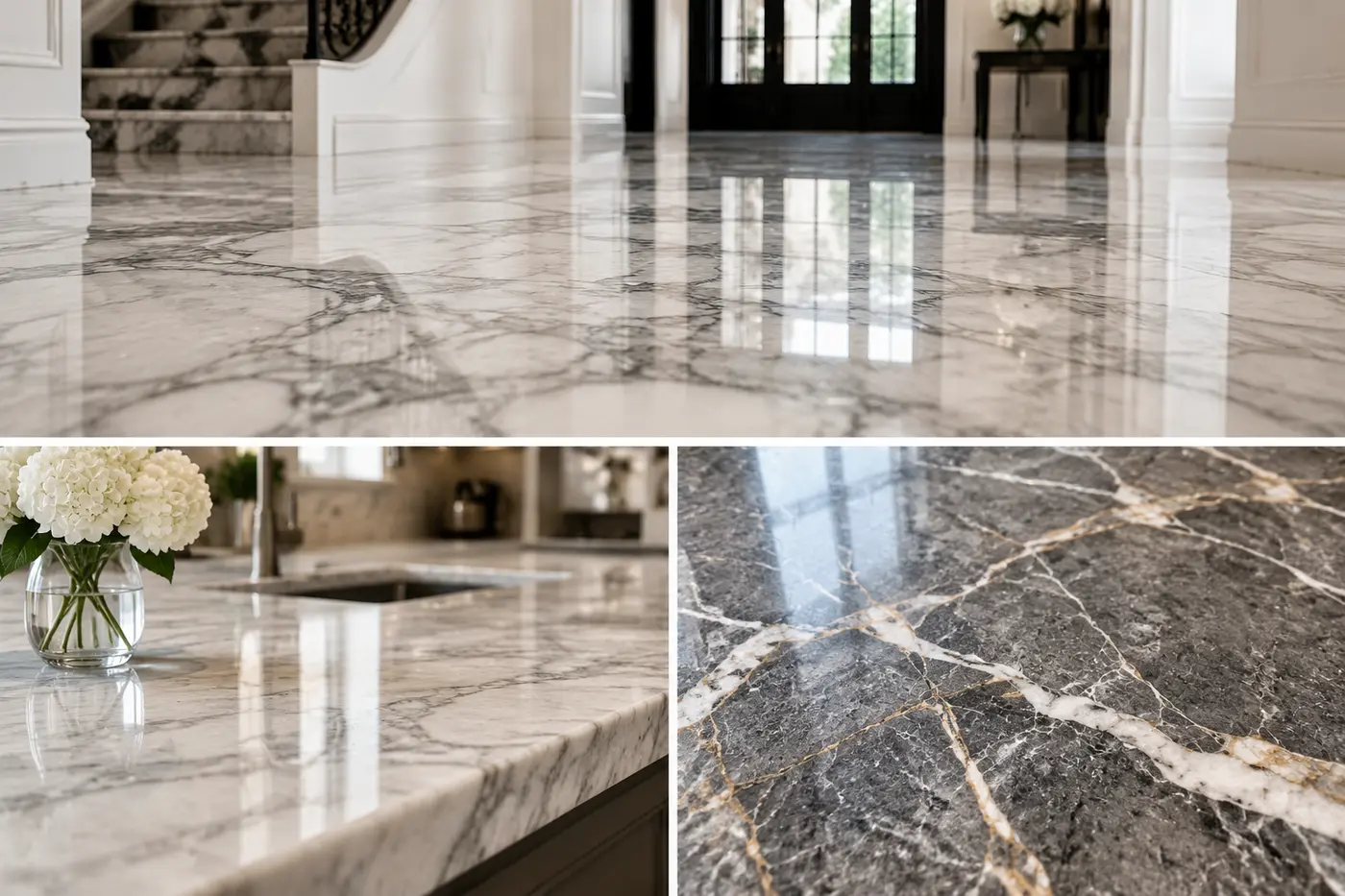
Polished white marble hallway floor with a staircase, a marble kitchen worktop and a close-up of grey marble with gold veining
Refined finish
Clarity and depth brought back
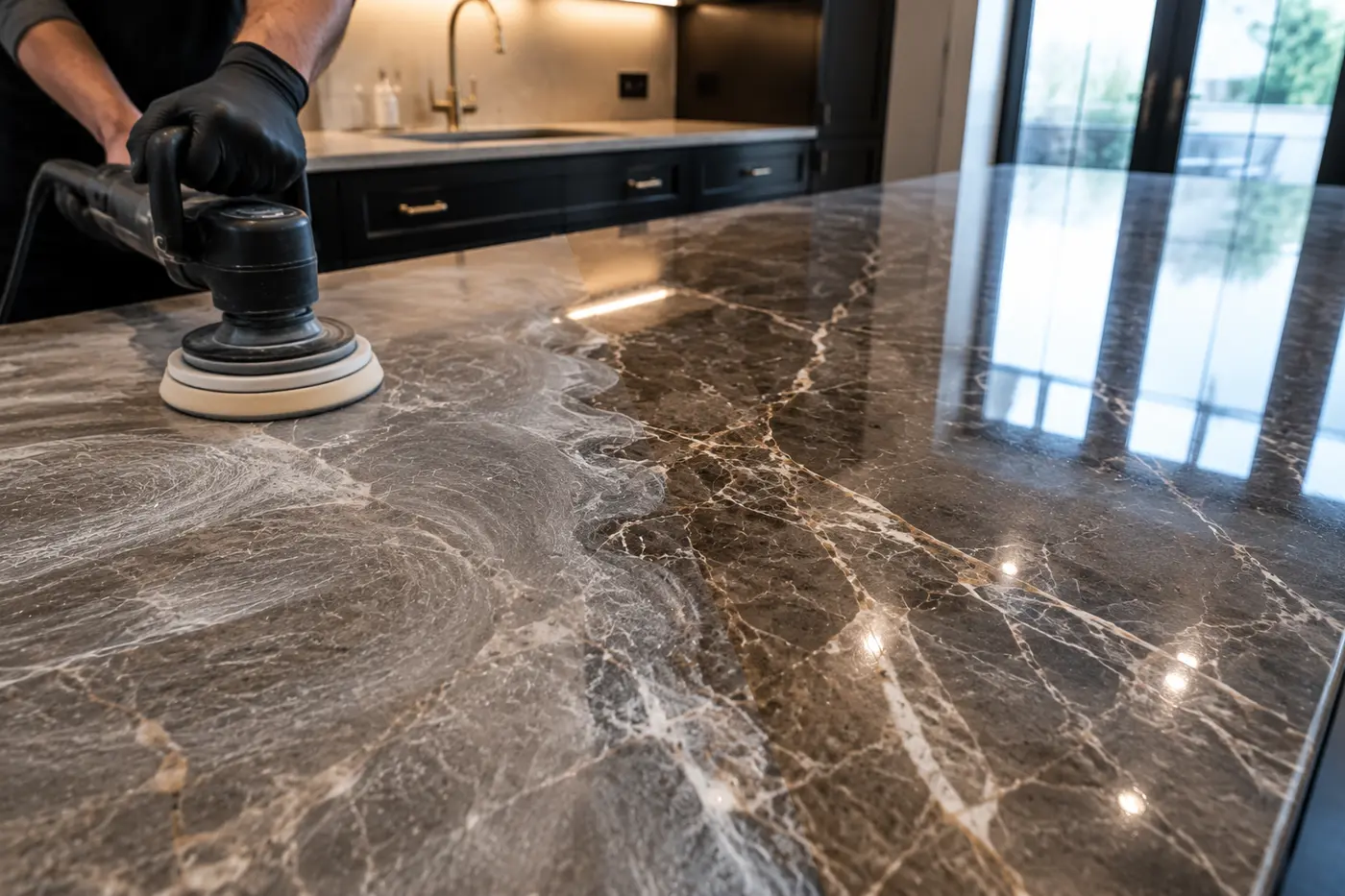
Technician polishing a grey marble kitchen island with a rotary machine
On site
Restored in place, room by room
Planning the visit

Working around occupied buildings

In a city of upper-floor flats, period interiors and venues that trade seven days a week, the logistics are often the part worth discussing first.

Access Shared stairs, narrow entrances, restricted parking and controlled-access buildings all affect how equipment is brought in. Knowing this in advance shapes the plan rather than delaying it on the day.
Protection Timber floors, carpets, joinery, skirtings and adjacent fittings are covered and protected before work begins, and dust-controlled machinery is used throughout.
Phasing Floors can be split into sections so part of a hall, corridor or lobby stays walkable, and worktops can be handled in one visit where the kitchen needs to be back in service.
Hours Hotels, bars, restaurants and offices are commonly worked overnight, early morning or at weekends. Tell us your quiet windows and the dates that are immovable.
Aftercare Practical guidance on cleaning products, mats at entrances, coasters on worktops and how to spot early etching, so the finish holds for as long as possible.
Request an assessment

Tell us about your Edinburgh marble.

Send the location and postcode, the approximate size of the area, the stone type if you know it, and clear photographs — one of the whole surface and a close-up of the damage taken at a low angle, so marks catch the light and show up properly.

For flats and period properties, let us know the floor level and whether there is lift access. For hotels, venues and offices, the hours the area can be handed over are the most useful detail you can give us. We will review everything and come back to you to discuss the likely method and the next step.

Prefer to speak to someone?
0800 050 2250

Related services

Explore the individual services

Each service page sets out the process in more detail. All are available to properties in Edinburgh.

Marble floor restoration

Multi-stage honing and polishing for dull, worn or lightly scratched marble floors, halls, stairs and lobbies.

Explore service →

Etch & scratch removal

Controlled refinishing for acid etch marks, ring marks and fine scratching on floors, worktops and vanities.

Explore service →

Worktop restoration

Restoration of marble worktops, islands, vanity tops, bar tops and tables, with colour-matched repairs where required.

Explore service →

Elsewhere in the country? See all of our areas covered across Scotland, including marble restoration in Glasgow.

Call 0800 050 2250