Floors, halls & stairs
Vestibule and entrance hall floors, hallways and corridors, landings, marble stair treads and risers, thresholds and inlaid borders, plus lobby and reception floors in commercial buildings.
Honing, polishing, etch and ring mark removal, repair and sealing for marble floors, entrance halls, worktops and architectural stone in Glasgow homes, offices, hotels, retail units and commercial properties.
Glasgow property covers a wide range of building types, from sandstone tenements and West End townhouses to Southside villas, converted warehouses, city centre offices and modern riverside apartments. Marble turns up in all of them: vestibule and hall floors, kitchen islands, bathroom vanities, fireplaces and reception areas.
Marble is a soft, calcite-based stone. Its polish is not a coating but the stone's own surface, refined until it reflects light evenly. That means a dull, etched or lightly scratched surface has usually not been destroyed — the top few microns have simply been damaged. Removing that damaged layer with graded diamond abrasives and re-refining the stone can bring back clarity and depth without lifting or replacing anything.
How far a surface can be improved depends on the stone type, the depth of damage and any previous treatments, which is why every job starts with an inspection and a test area rather than a fixed promise.
Domestic and commercial surfaces, from a single vanity top to a full entrance hall or lobby floor.
Vestibule and entrance hall floors, hallways and corridors, landings, marble stair treads and risers, thresholds and inlaid borders, plus lobby and reception floors in commercial buildings.
Kitchen worktops, islands and breakfast bars, splashbacks, bathroom vanity tops and basin surrounds, shower and wet room walls, bath surrounds and window sills.
Fireplaces, hearths and mantels, wall cladding and feature panels, reception counters, bar tops, table tops and statement slabs, plus columns and other polished stone details.
Alongside marble, the same staged approach applies to other calcite-based and polishable stone such as limestone, travertine, terrazzo and polished granite. If you are unsure what your surface is, photographs usually tell us enough to advise on the likely method.
Most enquiries are not about dramatic damage. They are about a surface that has quietly lost its finish and no longer responds to cleaning.
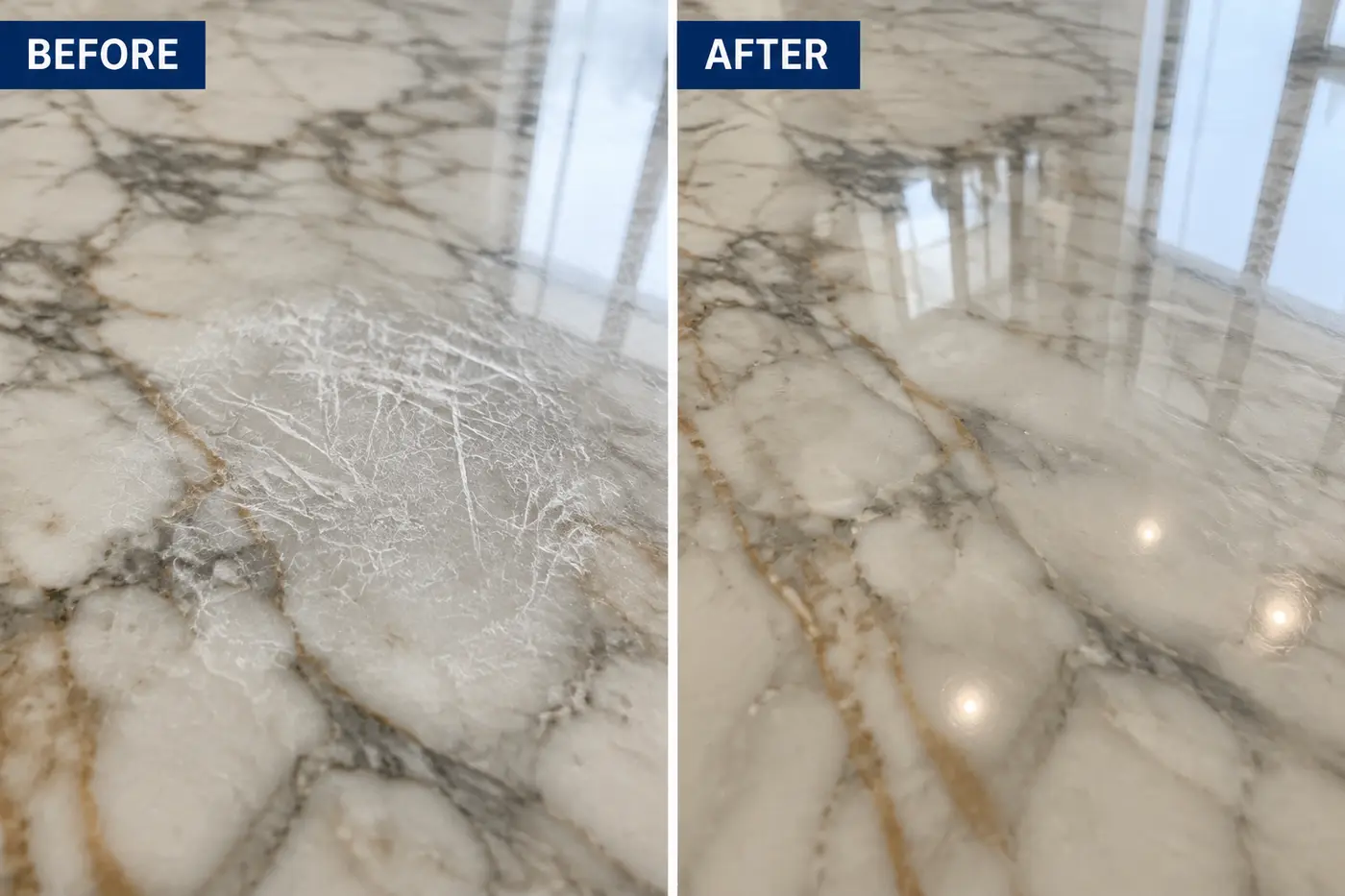
A staged process, with the abrasive sequence and final finish chosen around the stone and the way the space is used.
Identify the stone, the existing finish and any coatings. Assess the depth of etching and scratching, check for lippage between tiles, review loose or failed grout, and discuss how the room is used and what finish you want.
Work a discreet trial area first. This confirms how the stone responds, establishes a realistic result before the main work begins, and lets you see and approve the intended finish rather than take it on trust.
Work through graded diamond abrasives, coarse to fine, removing the damaged surface layer and flattening the stone. Where a floor is uneven, this stage also addresses lippage so tile edges no longer catch.
Refine to the agreed finish — a matt honed look, a soft satin sheen or a deeper polish. Slip resistance, lighting and how obvious future marks will be all influence the sensible choice, particularly in busy entrance halls.
Where suitable, apply an impregnating sealer that sits within the stone to slow the absorption of spills. Sealing reduces staining risk; it does not make marble acid-proof, so we also leave clear, practical aftercare advice.
Chips, small cracks and open seams can be filled with colour-matched resin during the process, so repairs are refined flush as part of the honing and polishing stages rather than sitting proud of the surface.
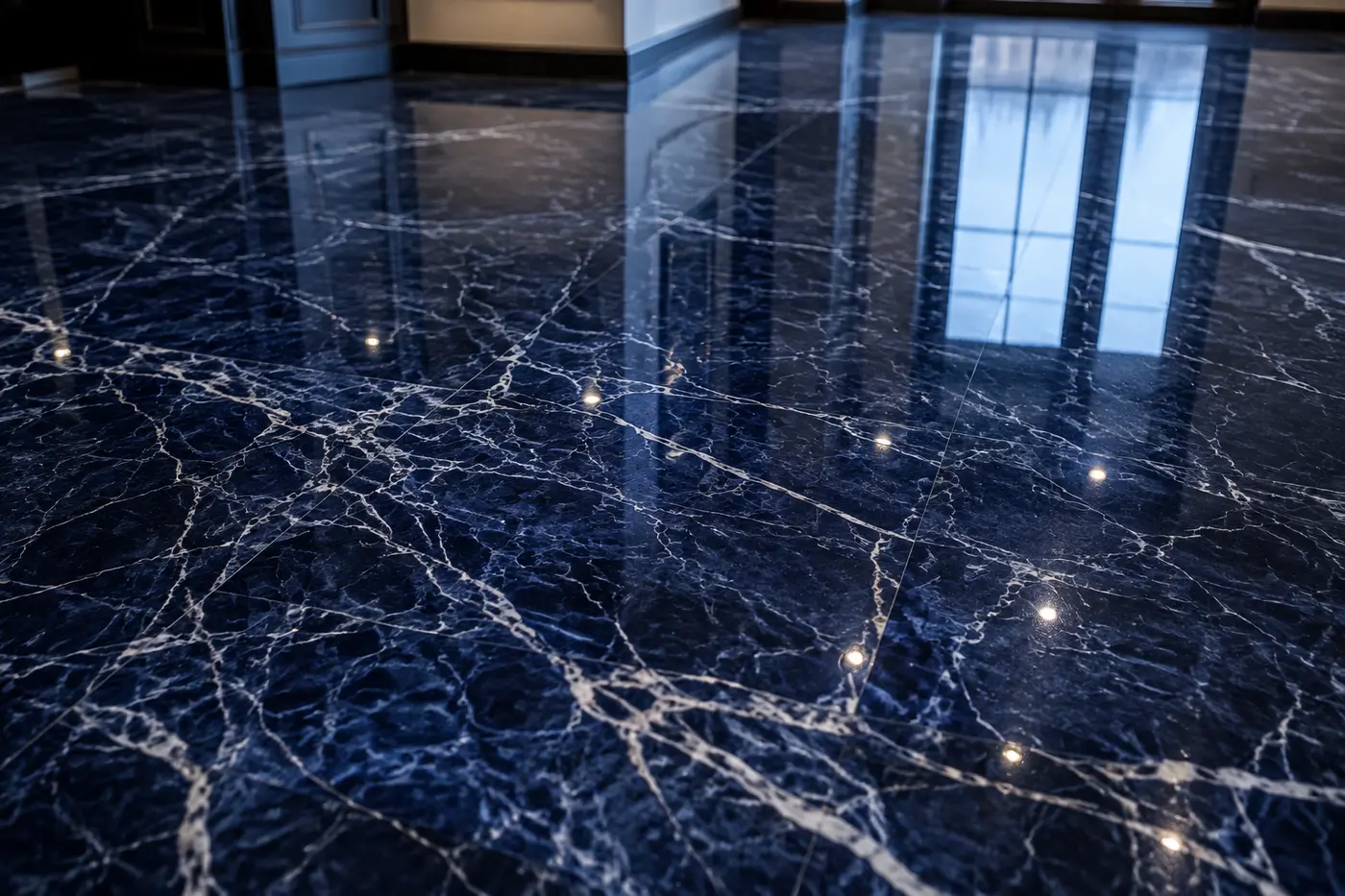
The technique is the same; the planning is not. Domestic work is usually scheduled room by room, while commercial floors are phased around trading and opening hours.
Send the property location and postcode, the approximate size of the area, the stone type if you know it, and clear photographs — one showing the whole surface and a close-up of the damage taken from a low angle so marks catch the light. We will review the details and come back to you to discuss the likely method and the next step.
If the surface is in a shop, office, hotel or managed building, it also helps to know your access hours and any dates the area must stay open.
Prefer to speak to someone?
0800 050 2250
Each service page covers the process in more detail. All of them are available to properties in Glasgow.
Multi-stage honing and polishing for worn, dull or lightly scratched marble floors, including entrance halls, corridors and stairs.
Explore service →Controlled refinishing for acid etch marks, ring marks and light surface scratches on floors, worktops and vanities.
Explore service →Restoration of marble worktops, islands, breakfast bars, vanity tops and tables, with colour-matched repairs where needed.
Explore service →Outside the city? See every location in our areas covered across Scotland, including marble restoration in Edinburgh.